Tuesday, 11 March 2014

Urtica dioica: Common Nettle

Known widely as Stinging Nettle due to its sting to prevent animals from trying to eat it. A very widespread and common plant that grows best on nitrogen enriched and disturbed soils. These nettles are in an open field and stand out in clumps as they are one of the few thing the rabbits won't chew. they can grow up to 1m tall but are often managed and cut back.


It's leaves are oval with pointed tips and toothed margins. They are in opposite pairs and grow to 8cms long. They have pendulous catkins during June-September. Their fruits resemble flowers.

Cotoneaster horizontalis: Wall Contoneaster

A stiff shrub with dividing branches that spreads in a flat plane. It is deciduous but leaves appear very early. Widely grown in gardens like this one, growing up the front of someone's house but occasionally naturalised, mainly on calcareous soils. They grow to a height of roughly 1m with a spread of 3m. They are a common plant often chosen for their hardiness and low cost.  


They have bright red spherical berries and solitary, pink flowers come out in May-June. The glossy leaves are 5-10mm long.

Salix fragilis: Crack Willow

I found this large mature crack willow in Ivel springs next to a small stream where I spent a lot of my childhood playing in the woods. It has a broadly domed crown and a thick bole with a large base. The branches are arising from low down near the base.


The bark is dull grey-brown covered with with interlocking crisscrossed ridges. The shoots are dull reddish brown, becoming brighter in early spring as leaves emerge. Leaves are long and glossy with toothed margins and have short green petioles.


This willow has recently dropped a large branch which has formed a makeshift bridge across the river. Perfect for me as a child. Crack Willows often drop branches or small twigs that can be carried along by a river and if they lodge into a bank will root and can form another tree. Often river banks will be lined with same sex trees all derived from pieces of the same tree.  


It has a small Sambucus shrub growing at the base along with Urtica dioica. It also seems to have some form of moss growing around the bottom of the base.


This is another Crack Willow located nearby. This has an unusual shape to the base and looks as if it has grown out of fallen branches forming this root like feature.

Sunday, 9 March 2014

Ligustrum ovalifolium: Garden Privet

A much-branched, evergreen spreading shrub. It is seen as a very common hedging shrub found in many front gardens, such as this young specimen. They grow to about 3m heigh and it will take roughly 5-6 years before these shrubs will act as a tall screening hedge.


The branches are dense much divided with downy young twigs. They have creamy white, fragrant, 4 petalled flowers during May- June and shiny, round, poisonous fruits that become black and ripe in autumn and grow in clusters.   


The bark is reddy brown with vertical scar like gashes. The leaves are rounded-oval and are good food for larvae.

Prunus laurocerasus: Cherry Laurel

This is an small evergreen tree or in this case a shrub in my garden. Laurels are often planted as an ornamental species. They produce suckers freely and self seeds so often spreads out to produce dense thickets. 


The leaves are leathery and oblong with a short-pointed tip and rounded tapering base. They grow to 20cm long and 6cm wide. They have very small teeth at intervals. The leaves also contain cyanide.


The bark is dark greyish brown, with many lenticles. The branches are dense with smooth pale green twigs. 


They grow fragrant white flowers about 13cm long fruits that turn from green to red to black.


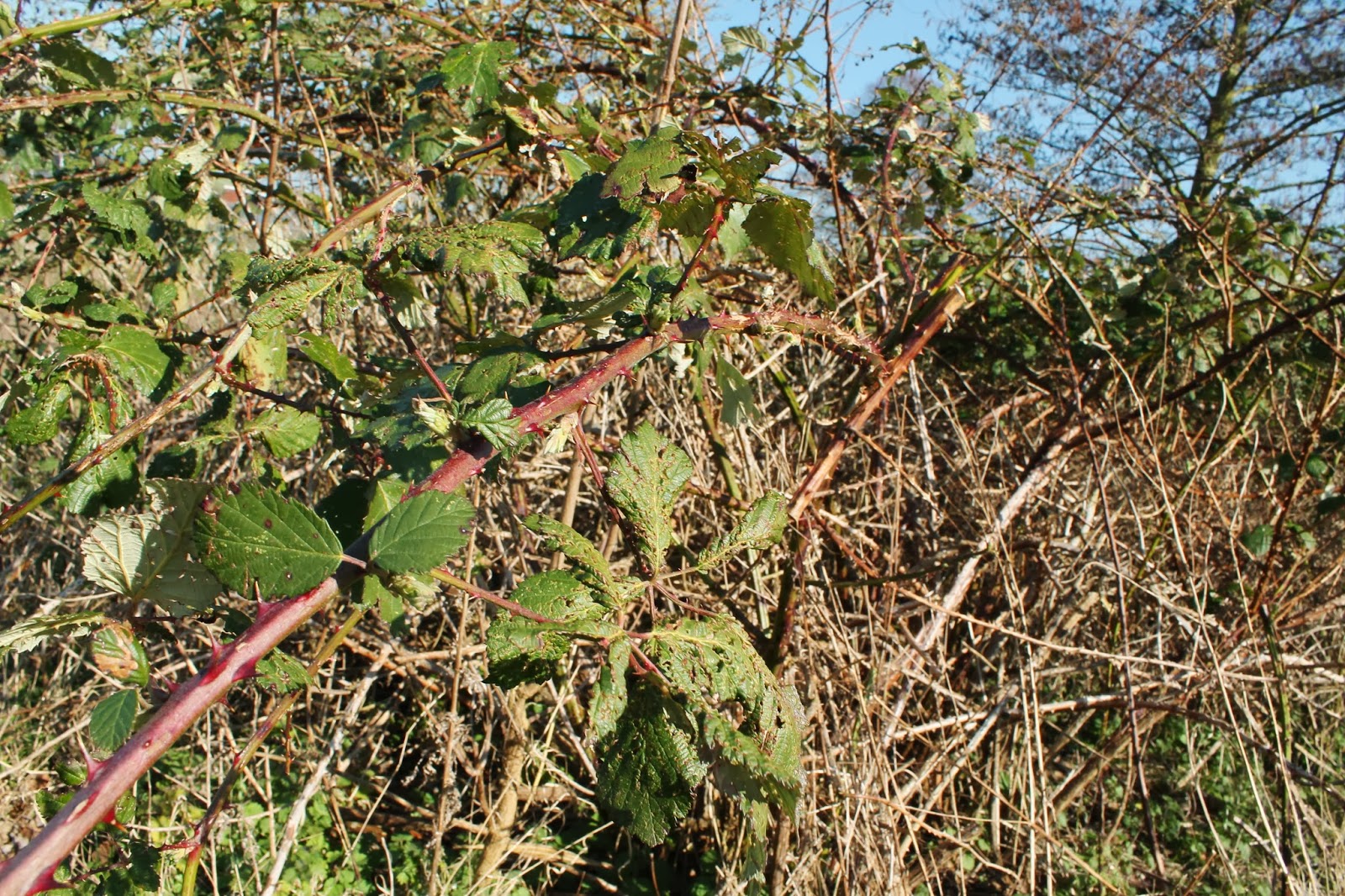
Rubus fruticosus: Bramble

Bramble is a very common swarming shrub that has hundreds of microspecies. Arching stems shown below have variable shaped prickles that root when they touch the floor. Often found in hedgerows and scrub. This one was found along the riverside in Ivel Springs.


Grows to roughly 3m high with 3-5 toothed leaflets and 2-3cm pink or white flowers and producing blackberries in May-August.


Many dead woody stems lie at the bottom of the shrub. This makes a great habitat for many animals including mice.

Buddleia davidii: Butterfly Bush

This Butterfly Bush self seeded in my garden in Hertfordshire. They grow on waste and disturbed ground often along coasts and railway embankments. My house is located next to Baldock railway station and many are found nearby.  They are robust shrubby perennials with long, arching branches. They require very little care and can grow in places with minimal soil, nutrients and water. Often found growing out of small cracks in walls and pavements.


This is a fairly mature butterfly bush that has been pruned many times as it is a very fast spreading shrub. It has a thick base with multiple stems growing out. 


The flowers 3-4mm across and during June-September are a vibrant pinkish, purple colour in long spikes. These are very attractive to butterflies. The leaves are long and narrow and are darker on top.